
A New Paradigm: Quantitative Cell Biology
The Science and Technology Center for Quantitative Cell Biology is working to develop 4D (space plus time) computer models of whole cells, functioning under normal and stressed conditions, and develop cutting-edge tools to record datasets with unprecedented resolution of subcellular dynamics and composition.
The research, education, and knowledge transfer is leading to a new discipline – quantitative cell biology – and providing training for researchers, students, and society.
Using cutting-edge imaging and simulation tools as well as experimental methods, the center is advancing the study of healthy and diseased cells, as well as accelerating research into metabolism, cell division, and gene expression. We’re also sharing science with communities of all ages through a partnership with the popular computer game Minecraft.

PNNL-QCB collaboration produces first 4D whole-cell model of a photosynthetic microbe
Researchers at Pacific Northwest National Laboratory teamed up with QCB scientists to create the first 4D whole-cell model of how a photosynthetic microbe responds to changing light. According to PNNL, “[t]his knowledge could inspire biotechnology and biomanufacturing approaches that use microbes to produce fuels, chemicals, materials, and other products … [and] could be relevant for potential quantum technology applications.”
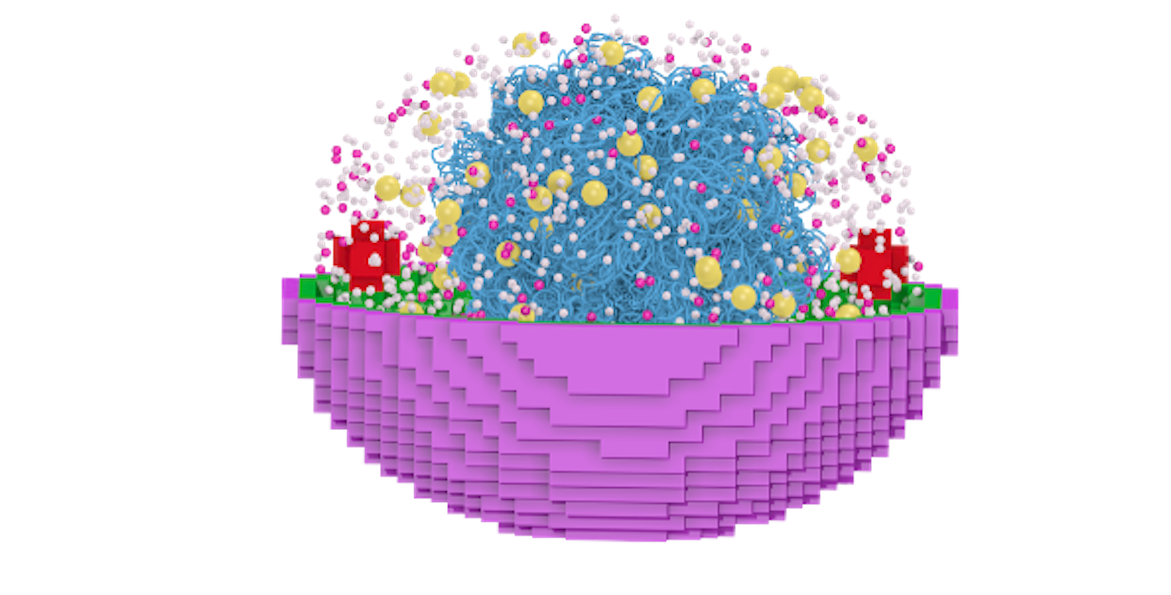
Shown at right is an image from a computer model of the photosynthetic marine microbe Prochlorococcus marinus MED4, built using detailed three-dimensional microscopy images and a modeled arrangement of its DNA. This reconstruction provides the starting point for simulations that help researchers understand how the cell’s internal organization influences its response to changing light.
Register now
for Illinois Biophysics Symposium
on November 18
Also accepting abstracts to present!
Biophysics combines biology with physics, mathematics, chemistry, and engineering to explore how living systems work. Biophysicists study everything from molecules and cells to the brain and immune system, using experiments, data, and technology to better understand life and solve biological problems.
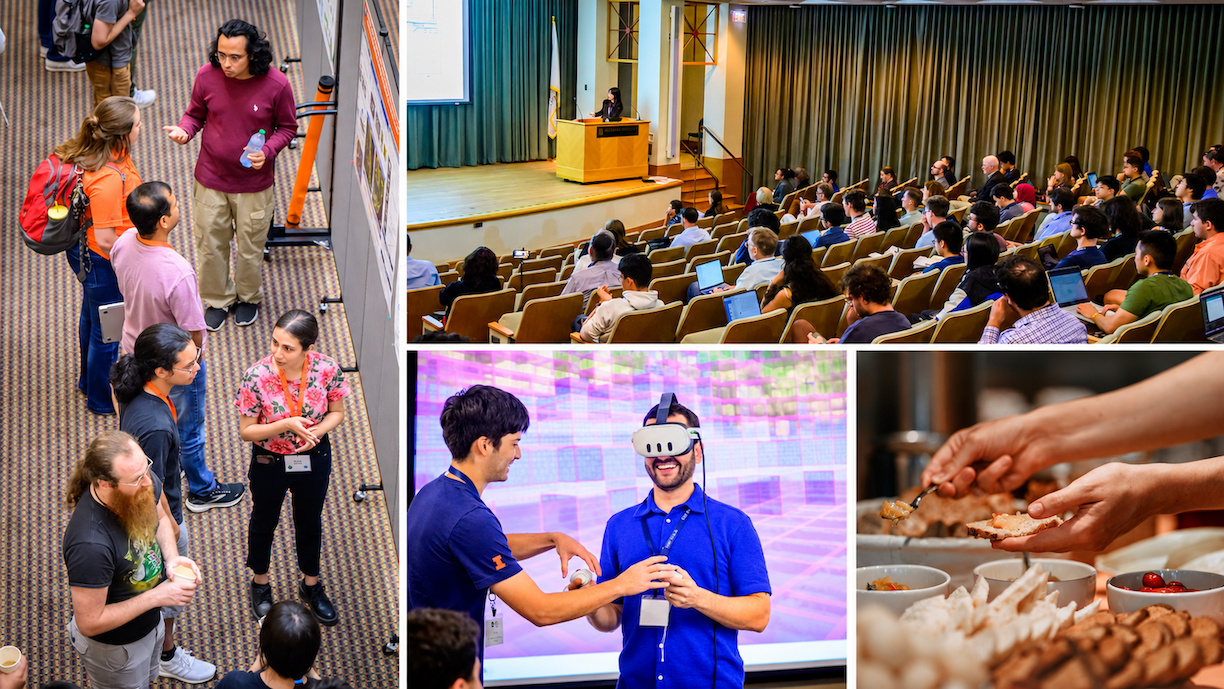
Join us November 18 for the 6th Illinois Biophysics Symposium to learn more about biophysics research at Illinois and where this field can take your career. Speakers, poster session, lunch, fun activities, from 10 am – 4:15 pm at the Beckman Institute.
View the schedule and register to attend and/or present HERE. Abstracts due October 25, registration closes November 10.
Scientific Breakthrough!
Our scientists have created the most detailed computer simulation yet of a living cell’s life cycle — opening a new window into the fundamental processes that make life possible.
Read more.
Video at right: This video shows the entirety of a simulated cell’s life cycle from birth to division into two new daughter cells. This process takes roughly 2 hours for the real cells, but took us roughly 4-6 days to simulate on the computer. As the cell membrane (green cubes) grows and divides, molecules like ribosomes (yellow/purple) have to stay inside the cell and molecules like the sugar transporters (grey) need to stay in the cell membrane. The cell’s singular chromosome (blue) expands to occupy most of the cell in this minimal bacteria and replicates once per life cycle to form a new copy of the DNA (red) for the daughter cell.